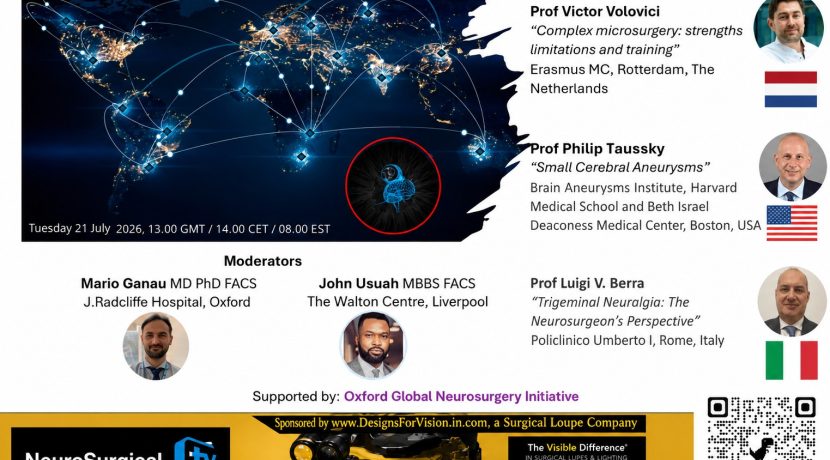
was LIVE July 21, 2026…..LIVE…………………………..TUESDAY, JULY 21, OXFORD Neurosurgery of ENGLAND, PRESENTS “GLOBAL NEUROSURGICAL GRAND ROUNDS” with three Presentations with CR-AI™ ANALYISIS
see webcast done July 21, 2026 https://www.youtube.com/live/8WW54bCPSIg?si=iElSzjPPhcxS1GiY&t=871
TUESDAY, 13: 00 PM GMT
Professor Victor Volovici, MD, PhD is a cerebrovascular and skull-base neurosurgeon at Erasmus University Medical Center in Rotterdam, the Netherlands. He serves as co-director of the Center for Complex Microvascular Surgery, leads neurovascular research, and is president of the Netherlands Neurovascular Society. He is also a visiting professor of experimental microsurgery at the Iuliu Hațieganu University of Medicine and Pharmacy in Romania. His principal interests include cerebral aneurysms, arteriovenous malformations, pediatric cerebrovascular disease, microsurgical education, clinical-research methodology, and evidence-based evaluation of emerging neurovascular treatments.
Professor Philipp Taussky, MD is an internationally recognized cerebrovascular and endovascular neurosurgeon at Beth Israel Deaconess Medical Center in Boston. He is co-director of the Brain Aneurysm Institute and associate professor of neurosurgery at Harvard Medical School. With advanced training in both open cerebrovascular surgery and minimally invasive endovascular techniques, his clinical expertise includes cerebral and spinal aneurysms, arteriovenous malformations, stroke, moyamoya disease, cavernous malformations, skull-base tumors, and other complex neurovascular disorders.
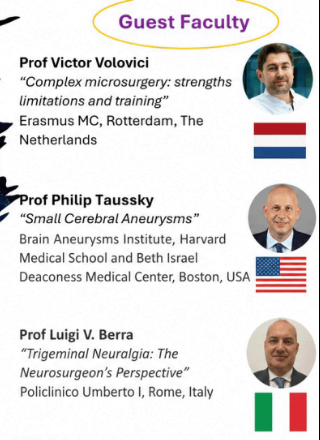
Luigi Valentino Berra, MD, PhD is an Italian neurosurgeon associated with the Department of Neurosurgery at Policlinico Umberto I–Sapienza University of Rome. He earned his medical degree from the University of Milan, completed his specialization in neurosurgery at the University of Verona, and pursued additional microsurgical training at Cornell University in New York. His clinical and academic work encompasses neurotrauma, intracranial hypertension, decompressive craniectomy, cerebrovascular surgery, brain tumors, spinal tumors, chordomas, and innovative neurosurgical technologies and reconstructive techniques.
ZOOM Registration Link
https://us06web.zoom.us/meeting/register/spBB2EZCSpq4nxV8Ti-vXw
MEETING #823 8753 3598
checked Passcode 423558
CR-AI™ TREATMENT OF THE THREE FEATURED FACULTY
Global Neurosurgical Grand Rounds
Presented by Oxford, England
CR-AI™—Clinical Relevance Artificial Intelligence—adds an educational layer to each faculty biography by identifying the immediate importance of the surgeon’s expertise and examining how artificial intelligence may influence that area of neurosurgery.
PROFESSOR VICTOR VOLOVICI, MD, PhD
Professor Victor Volovici is a cerebrovascular and skull-base neurosurgeon at Erasmus University Medical Center in Rotterdam, the Netherlands. He serves as co-director of the Center for Complex Microvascular Surgery, leads neurovascular research, and is president of the Netherlands Neurovascular Society. He is also a visiting professor of experimental microsurgery at the Iuliu Hațieganu University of Medicine and Pharmacy in Romania.
His principal interests include cerebral aneurysms, arteriovenous malformations, pediatric cerebrovascular disease, microsurgical education, clinical-research methodology, and the evidence-based evaluation of emerging neurovascular treatments.
CR—Clinical Relevance
Professor Volovici’s work is highly relevant to the management of complex cerebrovascular disorders in which treatment decisions may involve microsurgery, endovascular therapy, radiosurgery, observation, or a combination of approaches.
His expertise is particularly important in:
- Selecting treatment for difficult cerebral aneurysms and arteriovenous malformations.
- Evaluating treatment risks in pediatric cerebrovascular disease.
- Improving microsurgical training and technical performance.
- Distinguishing genuine therapeutic advances from technologies supported by incomplete or biased evidence.
- Strengthening the methodology and interpretation of neurosurgical clinical research.
For residents and young neurosurgeons, his work emphasizes that excellent cerebrovascular care depends not only on operative technique but also on critical evaluation of evidence, patient selection, and long-term outcomes.
AI—Artificial Intelligence Opportunities
Artificial intelligence could support this field through:
- Automated detection and segmentation of aneurysms and vascular malformations.
- Prediction of aneurysm rupture, treatment complications, and long-term outcomes.
- Three-dimensional reconstruction of vascular anatomy for operative planning.
- Identification of microsurgical corridors and structures at risk.
- Analysis of operative video for technical education and performance assessment.
- AI-assisted systematic reviews and evaluation of clinical evidence.
- Detection of bias, methodological weaknesses, and inconsistencies in published research.
CR-AI™ Educational Focus
Professor Volovici’s presentation provides an opportunity to examine how neurosurgeons can combine microsurgical excellence, scientific methodology, and carefully validated artificial intelligence without allowing new technology to replace clinical judgment.
PROFESSOR PHILIPP TAUSSKY, MD
Professor Philipp Taussky is an internationally recognized cerebrovascular and endovascular neurosurgeon at Beth Israel Deaconess Medical Center in Boston. He is co-director of the Brain Aneurysm Institute and an associate professor of neurosurgery at Harvard Medical School.
With advanced training in both open cerebrovascular surgery and minimally invasive endovascular techniques, his clinical expertise includes cerebral and spinal aneurysms, arteriovenous malformations, stroke, moyamoya disease, cavernous malformations, skull-base tumors, and other complex neurovascular disorders.
CR—Clinical Relevance
Professor Taussky represents the modern hybrid cerebrovascular specialist who can evaluate a patient from both microsurgical and endovascular perspectives.
This dual expertise is clinically important because many neurovascular conditions can now be treated by several competing approaches. The central question is no longer simply whether a lesion can be treated, but which treatment offers the safest and most durable result for the individual patient.
His experience is particularly relevant to:
- Choosing between clipping, coiling, flow diversion, bypass, embolization, and observation.
- Treating complex or previously treated cerebral aneurysms.
- Managing acute ischemic and hemorrhagic stroke.
- Planning cerebral revascularization for moyamoya disease.
- Treating spinal vascular malformations and aneurysms.
- Integrating open surgery with endovascular treatment.
- Managing lesions requiring multidisciplinary neurovascular care.
AI—Artificial Intelligence Opportunities
Artificial intelligence may contribute to these areas through:
- Rapid detection and triage of ischemic stroke and intracranial hemorrhage.
- Automated analysis of CT angiography, MR angiography, and catheter angiography.
- Prediction of collateral circulation and brain tissue viability.
- Modeling of aneurysm hemodynamics and wall stress.
- Selection of patients for thrombectomy, bypass, flow diversion, or microsurgery.
- Virtual simulation of endovascular-device deployment.
- Navigation and robotic assistance during endovascular procedures.
- Comparison of predicted outcomes for open and endovascular treatment strategies.
CR-AI™ Educational Focus
Professor Taussky’s presentation offers an ideal setting for demonstrating how AI might assist treatment selection across the complete neurovascular spectrum. The objective is not for an algorithm to choose the operation, but to provide the surgeon with better imaging analysis, risk prediction, and individualized comparisons of available treatments.
LUIGI VALENTINO BERRA, MD, PhD
Luigi Valentino Berra is an Italian neurosurgeon associated with the Department of Neurosurgery at Policlinico Umberto I–Sapienza University of Rome.
He earned his medical degree from the University of Milan, completed his specialization in neurosurgery at the University of Verona, and pursued additional microsurgical training at Cornell University in New York.
His clinical and academic work encompasses neurotrauma, intracranial hypertension, decompressive craniectomy, cerebrovascular surgery, brain tumors, spinal tumors, chordomas, and innovative neurosurgical technologies and reconstructive techniques.
CR—Clinical Relevance
Dr. Berra’s broad experience connects emergency neurosurgery, neuro-oncology, cerebrovascular surgery, spinal surgery, and complex reconstruction.
His work is clinically relevant to several difficult questions:
- When should a patient with traumatic brain injury undergo surgical decompression?
- Which patients are most likely to benefit from decompressive craniectomy?
- How should intracranial pressure be monitored and interpreted?
- How can cranial reconstruction be improved following major decompressive surgery?
- How should complex brain, spine, and skull-base tumors be approached?
- How can new technologies be introduced without increasing unnecessary risk or cost?
His combination of neurotrauma and reconstructive experience is especially important because survival is only the first objective. Neurological recovery, cranial protection, reconstruction, cosmetic outcome, and quality of life must also be considered.
AI—Artificial Intelligence Opportunities
Artificial intelligence could assist these areas through:
- Automated identification of traumatic intracranial hemorrhage on CT imaging.
- Measurement of hematoma volume, midline shift, ventricular compression, and cerebral edema.
- Prediction of intracranial-pressure deterioration.
- Early identification of patients who may require surgery.
- Outcome prediction following decompressive craniectomy.
- Continuous analysis of multimodal neurocritical-care monitoring.
- Tumor segmentation and operative-corridor planning.
- Three-dimensional modeling of skull, spine, and skull-base defects.
- Customized cranial-implant and reconstructive planning.
- Postoperative imaging analysis and complication detection.
CR-AI™ Educational Focus
Dr. Berra’s presentation allows CR-AI™ to explore how artificial intelligence may assist urgent neurosurgical decision-making while also improving operative planning, reconstruction, postoperative surveillance, and long-term functional outcomes.
OVERALL CR-AI™ GRAND ROUNDS PERSPECTIVE
Together, these three faculty members represent complementary areas of modern neurosurgery:
Professor Volovici: microsurgical neurovascular expertise, research methodology, and evidence-based evaluation.
Professor Taussky: integration of open cerebrovascular and endovascular treatment.
Dr. Berra: neurotrauma, intracranial-pressure management, tumors, emerging technology, and reconstruction.
The CR-AI™ treatment of this program will focus on five central questions:
- What information is most clinically important for the practicing neurosurgeon?
- How should treatment options be compared for the individual patient?
- Where can artificial intelligence improve diagnosis, planning, and outcome prediction?
- Which decisions must remain under the direct control of the neurosurgeon?
- How can new technology be validated before widespread clinical adoption?
CR-AI™ PRINCIPLE
Artificial intelligence should not replace the neurosurgeon. It should help the neurosurgeon recognize important information earlier, understand complex anatomy more clearly, compare treatment options more accurately, and make better-informed decisions for each patient.
REGISTRATION INFORMATION
Tuesday, July 21, 2026
Time: 13:00 GMT
Free Zoom Registration:
https://us06web.zoom.us/meeting/register/spBB2EZCSpq4nxV8Ti-vXw
Meeting ID: 823 8753 3598
Passcode: 423558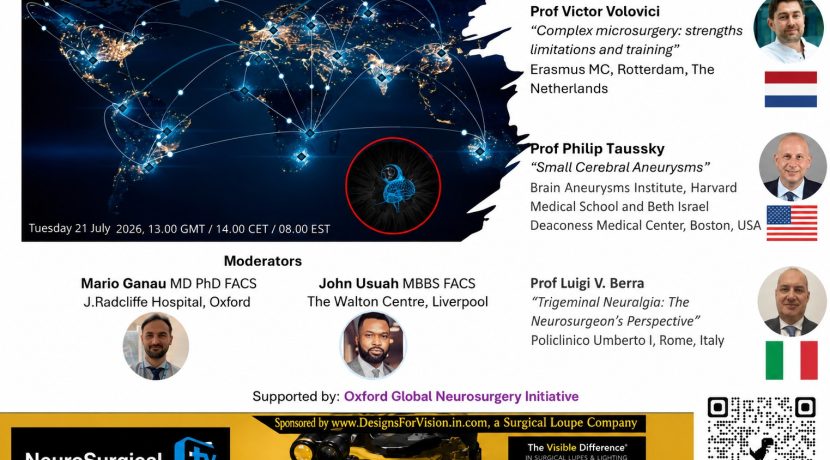
OUR SPONSORS this week is www.DesignsForLiving.com, a Surgical Loupe company from Bohemia, New York; scan the QR Code to see slideshow of their SURGICAL LOUPES
 Author: desertedbeach