AI in Neurosurgery: What Can We Actually Use Today?
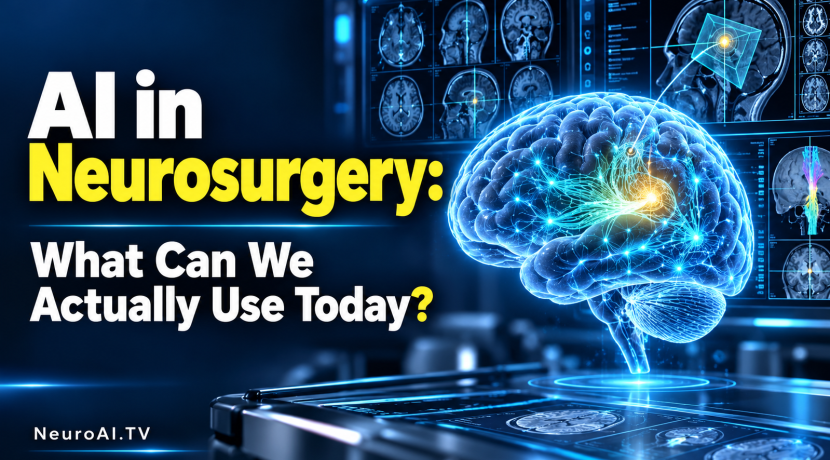
AI in Neurosurgery: What Can We Actually Use Today?
We can already use AI to flag urgent imaging, help prepare surgical plans, and draft clinical documentation. Its practical value lies in specific tasks that clinicians can check—not independent surgical judgment.
| Use today | Practical example | What the clinician must verify |
|---|---|---|
| Urgent imaging alerts | AI flags suspected intracranial hemorrhage on CT and prioritizes review. | Examine the complete scan; missed findings and false alerts remain possible. |
| Aneurysm triage | Viz ANEURYSM analyzes head CTA for suspected aneurysms and alerts the clinical workflow. | Confirm the finding and independently assess treatment options. |
| Tumor segmentation and planning | Brainlab Elements offers AI tumor segmentation alongside cranial planning and visualization tools. | Check tumor boundaries and nearby anatomy before using the plan. |
| Radiosurgery preparation | AI-assisted segmentation can help outline supported cranial tumors and structures at risk. | Review and approve every contour and the treatment plan. |
| Clinical documentation | Tools such as Dragon Copilot draft encounter notes from recorded conversations. | Correct omissions, invented details, examination findings, and the final plan. |
The imaging examples have specific FDA-cleared triage indications; they do not replace standard image interpretation. Brainlab’s available modules and indications depend on the product and jurisdiction. Documentation tools produce drafts for clinician review. accessdata.fda.gov
For neurosurgical education, AI is also useful for preparing case-discussion outlines, simplifying explanations, translating teaching material, and summarizing supplied papers. These are reasonable starting points for NeuroAI.TV, provided a knowledgeable reviewer checks the content and original references.
What should we avoid treating as routine dependable care? A general chatbot choosing the operative approach, deciding whether to operate, interpreting an uploaded scan as a definitive diagnosis, or guaranteeing an individual patient’s outcome. Device authorization applies to a particular task—not to everything an AI system might claim it can do. FDA
For a practical webcast, I would demonstrate three workflows: an imaging alert, a reviewed tumor segmentation, and an AI-drafted clinical note—showing both the useful output and the corrections required.
AI, DeepRelevance™ (DR), and CR‑AI™ are educational tools—not substitutes for professional medical judgment—and all AI-generated information must be independently verified.
Convert to PDF
 Author: desertedbeach