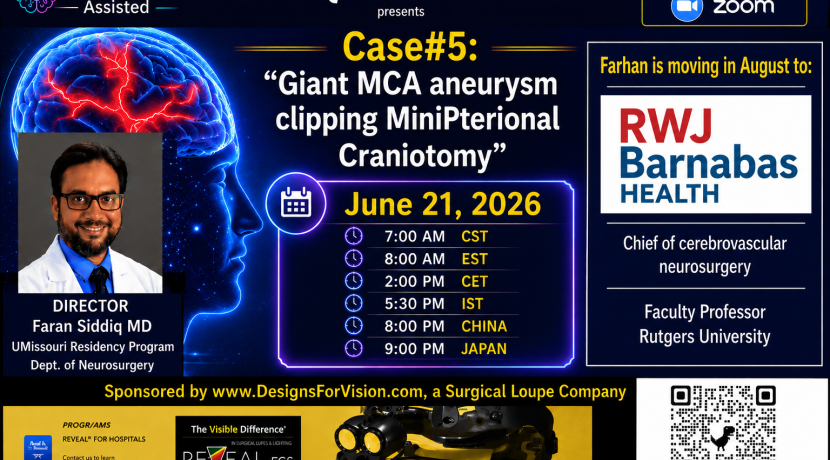
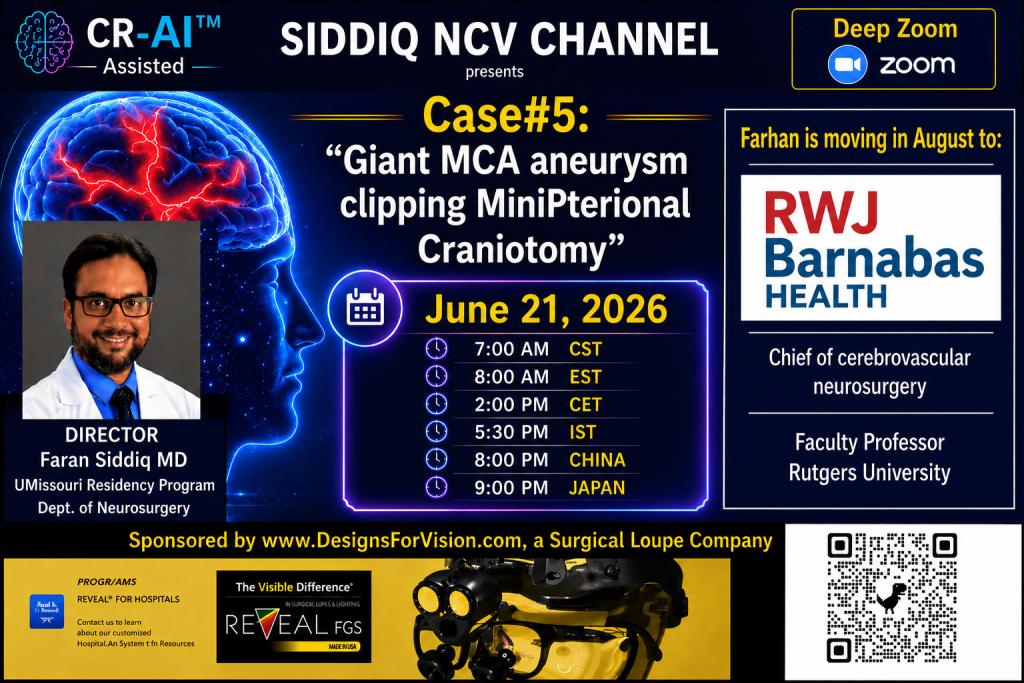
SUNDAY, 7am CST, from the SIDDIQ NCV CHANNEL,, FARAN PRESENTS “Giant MCAA Aneurysm clipping MiniPteritonal Craniotomy”, with Deep Zoom CR-AI™ DeepZoom™ Clinical Relevance Analysis Case #5: Giant MCA Aneurysm Clipping via Mini-Pterional Craniotomy Presented by Farhan Siddiq, MD Siddiq NCV Channel | DeepZoom™ Powered by CR-AI™ ZOOM LINK: https://us06web.zoom.us/meeting/register/N-gRd39nQ6WacvFE_cmq5Q MEETING ID: 831 3508 0881 Passcode 977315 Most neurosurgical webinars teach how an operation is performed.
CR-AI™ and
DeepZoom™
are designed to answer the equally important question:
Why does this operation matter, when should it be performed, and what are the lessons every cerebrovascular neurosurgeon should remember? A giant middle cerebral artery (MCA) aneurysm represents one of the most technically demanding lesions in cerebrovascular surgery. Giant aneurysms are often partially thrombosed, heavily calcified, involve multiple arterial branches, distort normal anatomy, and carry a significant risk of rupture, ischemia, and neurological disability. Unlike smaller aneurysms, these lesions frequently require advanced microsurgical judgment rather than straightforward clip placement. This webcast is particularly valuable because it highlights the Mini-Pterional Craniotomy, an increasingly refined skull base approach that seeks to achieve maximal microsurgical exposure through a significantly smaller operative corridor. Rather than emphasizing large cranial openings, modern vascular neurosurgery focuses on minimizing tissue disruption while maintaining excellent visualization, adequate proximal vascular control, and precise clip reconstruction. Through DeepZoom™, CR-AI™ can continually identify the clinical importance of what is being demonstrated. As the operation progresses, the system could automatically recognize and emphasize concepts such as: why proximal vascular control determines operative safety, preservation of lenticulostriate perforators, management of temporary clipping, avoidance of ischemic complications, clip selection strategies, intraoperative rupture management, confirmation of complete aneurysm occlusion while preserving parent and branch vessels. Rather than simply watching an expert operate, viewers continuously learn why each maneuver changes patient outcome. Clinical Relevance For residents and young neurosurgeons, giant MCA aneurysms represent one of the best examples of where microsurgical expertise continues to outperform simplified treatment algorithms. Although endovascular therapy has transformed aneurysm management, complex giant MCA aneurysms frequently remain among the strongest indications for open microsurgical reconstruction. This webcast therefore becomes more than a surgical demonstration. It illustrates: 1) modern decision-making between microsurgery and endovascular therapy, 2) management of giant complex aneurysms, 3) skull base exposure through minimally invasive techniques, 4) preservation of neurological function, and 5) application of advanced vascular microsurgical principles. Surgical Pearls CR-AI™ Could Highlight Throughout the webcast, DeepZoom™ could automatically generate educational alerts such as: Clinical Pearl #1 Always obtain proximal control before definitive aneurysm manipulation. Clinical Pearl #2 Every millimeter of unnecessary brain retraction increases operative risk. Clinical Pearl #3 Temporary clips are tools—not solutions. Minimize ischemic time. Clinical Pearl #4 Protect perforating arteries even if clip placement becomes technically more demanding. Clinical Pearl #5 Complete aneurysm obliteration is important, but preservation of normal circulation is paramount. Common Pitfalls CR-AI™ would also identify potential complications discussed during surgery, including: inadequate Sylvian fissure dissection, poor proximal vascular exposure, excessive brain retraction, clip-induced vessel stenosis, perforator injury, intraoperative aneurysm rupture, incomplete aneurysm occlusion, postoperative cerebral infarction. By identifying these pitfalls in real time, DeepZoom™ transforms passive viewing into active surgical learning. Future Directions One of the most exciting aspects of this webcast is how it demonstrates where neurosurgical education is heading. DeepZoom™ has the potential to convert every operative webcast into a living educational resource by: generating real-time clinical relevance alerts, summarizing key operative steps, linking important surgical literature, creating personalized learning modules, automatically producing operative timelines, generating board-style examination questions, and preserving each lecture as a searchable knowledge base long after the live presentation concludes. Instead of simply recording surgery, CR-AI™ transforms the operation into a continuously expanding educational experience. Why This Webcast Matters This session is far more than a demonstration of aneurysm clipping. It represents the convergence of advanced cerebrovascular microsurgery, minimally invasive skull base philosophy, and AI-assisted medical education. For neurosurgeons, residents, fellows, and anyone interested in complex vascular surgery, this webcast offers a rare opportunity to observe the decision-making processes behind one of the most challenging operations in neurosurgery—enhanced by DeepZoom™, where CR-AI™ continually explains not only what is happening, but why it matters. This approach has the potential to redefine online neurosurgical education by making every lecture interactive, clinically relevant, and enduring as a permanent, searchable source of surgical knowledge.
 Author: desertedbeach


