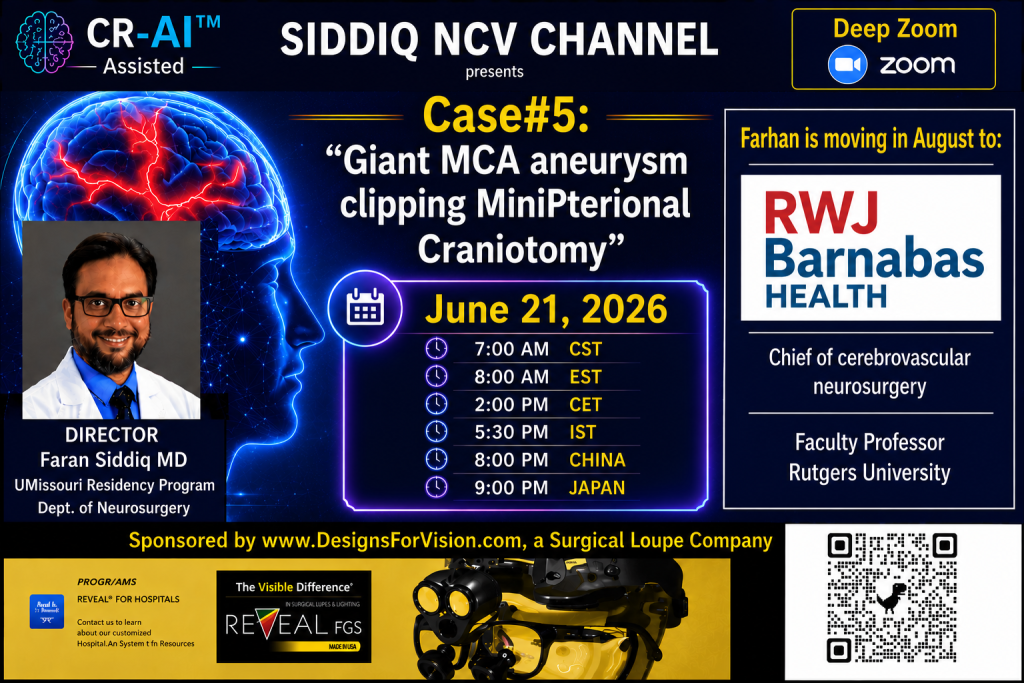
RECORDED, LIVE, SUNDAY, 7am CST, from the SIDDIQ NCV CHANNEL,, FARAN PRESENTS “Giant MCA Aneurysm clipping MiniPteritonal Craniotomy, with CR-AI™ and DeepZoom™

SEE LIVE, JUNE 21, 2026  https://www.youtube.com/embed/xQ49Z3UJb3g?si=8JOkg06Qsn59rGH5″ title=”YouTube video player” frameborder=”0″ allow=”accelerometer; autoplay; clipboard-write; encrypted-media; gyroscope; picture-in-picture; web-share” referrerpolicy=”strict-origin-when-cross-origin” allowfullscreen”   NOW RECORDED, SUNDAY, JUNE 21, 2026, from the SIDDIQ NCV CHANNEL,, FARAN PRESENTS “Giant MCA Aneurysm clipping MiniPteritonal Craniotomy”, with Deep Zoom
CR-AI™ DeepZoom™ Clinical Relevance Analysis

________________________________________________________________________________

YOUNG RESIDENTS AND STUDENTS, READ THIS BEFORE THE WEBCAST TO MAKE IT A COMPLETE EDUCATIONAL EXPERIENCE!!

____________________________________________________________

Case #5: Giant MCA Aneurysm Clipping via Mini-Pterional Craniotomy

Presented by Farhan Siddiq, MD
Siddiq NCV Channel | DeepZoom™ Powered by CR-AI™

ZOOM LINK: https://us06web.zoom.us/meeting/register/N-gRd39nQ6WacvFE_cmq5Q

          MEETING ID: 831 3508 0881

Passcode 977315

Most neurosurgical webinars teach how an operation is performed. CR-AI™ is designed to answer the equally important question:

Why does this operation matter, when should it be performed, and what are the lessons every cerebrovascular neurosurgeon should remember?

A giant middle cerebral artery (MCA) aneurysm represents one of the most technically demanding lesions in cerebrovascular surgery. Giant aneurysms are often partially thrombosed, heavily calcified, involve multiple arterial branches, distort normal anatomy, and carry a significant risk of rupture, ischemia, and neurological disability. Unlike smaller aneurysms, these lesions frequently require advanced microsurgical judgment rather than straightforward clip placement.

This webcast is particularly valuable because it highlights the Mini-Pterional Craniotomy, an increasingly refined skull base approach that seeks to achieve maximal microsurgical exposure through a significantly smaller operative corridor. Rather than emphasizing large cranial openings, modern vascular neurosurgery focuses on minimizing tissue disruption while maintaining excellent visualization, adequate proximal vascular control, and precise clip reconstruction.

                                                         (FOR MORE, GO HERE: https://www.neurosurgical.tv/fullsite/)